
Niedzwiecki
Apple
Недзвецкий алмасы
Malus Niedzwetzkyana Dieck.
1
The value of the taxon
in preserving the gene pool
A very rare, almost endemic, endangered species, with a small population. A rare decorative variety.
2
Distribution
It grows in Central Asia and the border regions of China, in the mountain forests of the Tien Shan.
Status. A very rare, almost endemic, endangered species, with an insignificant number.
The importance of the taxon in the preservation of the gene pool. A rare decorative variety.
Botanical description.
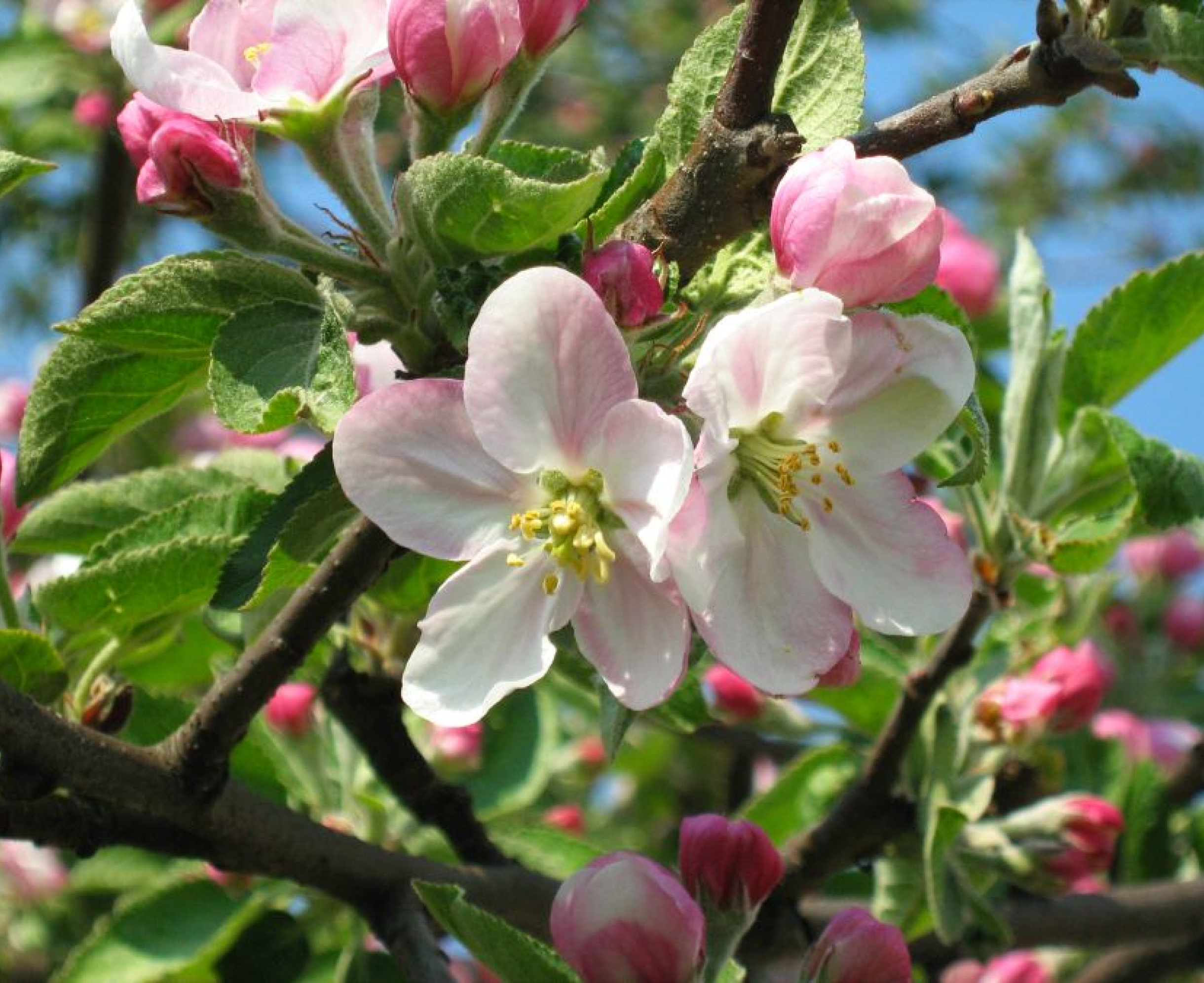
The Nedzvetsky’s apple tree is a small tree, 6-8 meters tall, with smooth branches without thorns, young shoots have a dark purple color. The leaves are also purple during the flowering period. When an apple tree acquires an abundant crown, only the petioles of the leaves remain intensely colored, the plate turns out to be dark green from above, and purple from below, slightly pubescent – this makes the crown color very peculiar. The flowers in the buds are dark purple, and when blooming they are intensely pink or purple, on thin, whitish flower stalks, which undoubtedly distinguishes it from the total mass of flowering apple trees. Flowering itself lasts an average of 10 days, but budding significantly lengthens the decorative phase. The simultaneous presence of buds and flowers on the branches, formed to varying degrees, creates an excellent color scheme. Wild apple trees are also spectacular in the autumn at the fruiting stage. The fruiting phase lasts up to one month. The fruits are a single spherical or slightly elongated apple of purple-purple color with a waxy coating and reddish flesh, about 16 ×18 mm (sometimes 3 times larger), with 1-9 benign seeds. The fruits ripen in September-October and remain on the tree for a long time. The seed is oblong, wedge-shaped or pointed-oval, smooth. This decorative apple tree has elliptical leaves with a serrated edge, narrowed to the top and base in the form of a wedge. In spring and early summer, these leathery, pubescent leaves on the reverse side have a red-brown color. Then they darken and turn purple, especially noticeable on the underside.
The fruits of this tree are mostly small and very small. Their diameter does not exceed 2.5-3 centimeters, and their weight can range from 10-25 grams. Basically, apples are one-dimensional, rounded, with weakly pronounced ribbing, may be slightly flattened. Their skin is very dense, thick, rather rough, at first green, and eventually greenish-yellow. At a ripe age, 80-99% is covered with a cover blush of red-beet or purple hue. Subcutaneous dots are gray or grayish-light green, numerous, poorly visible on the surface of the hearths due to a dense waxy bluish plaque. The flesh is dense, firm, crisp, pale pink or reddish, has a clear astringent, slightly bitter taste, reminiscent of the taste of wildfowl fruits. Trees of this variety are considered to be strong-growing, although usually in gardens they grow only up to 6-8 meters, no more. However, in the wild, there are cases when they stretched more than ten meters. The leaves have an oval, elliptical shape, are slightly elongated, with a long-pointed tip and a wavy finely-serrated edge. They are dense, mostly shiny and glossy, leathery, greenish red, crimson or red-purple in color. The Nedzvetsky’s apple tree is described as a tall tree, growing up to 8 meters. Cracks are almost invisible on the powerful smooth trunk. The bark without thorns is gray-brown or purple-brown, the crown has the shape of a ball, sometimes round. It can be elevated or sprawling. On the young branches of the decorative Nedzvetsky’s apple tree, the leaves are dark purple, when all the leaves bloom, the primary color remains only on the petioles. The leaves are dark emerald on top, and the lower part of the leaf plate is reddish with noticeable pubescence. The leaves are ovate, with a sharp tip, teeth on the edges. The Nedzvetsky’s apple tree becomes especially decorative at the time of flowering. The buds are pink-purple, and the flower itself becomes bright pink or purple after blooming.
The five-petalled flowers are large, up to 5 centimeters in diameter. The inflorescence consists of several buds with thin felt peduncles of white color. You can find out that there is a Nedzvetsky’s apple tree in the garden or park by its rich bright aroma. Decorative apple trees bloom for almost two weeks. Ovaries are formed in place of flowers. By the time of ripening, the apples grow up to 2-3 cm in diameter. Nedzvetsky’s apples are spherical or elongated with a dark red or purple-purple color. A waxy coating is clearly visible on each fruit. The flesh is pink on the cut. The number of seeds in Nedzvetsky’s apples varies from 1 to 9.
Distribution. It grows in Central Asia and the border regions of China, in the mountain forests of the Tien Shan.
Habitats. Moist, drained, loamy and clay soils with a reaction from slightly acidic to slightly alkaline. It does not tolerate salinization of the soil. It does not tolerate waterlogging, adult plants are relatively resistant to soil drought and soil over-compaction.
Using.
This small apple tree is used for decorative purposes. It looks very good both singly and as part of a hedge. The blossoming leaves, as well as the branches, have a dark purple color.
But blooming to the end, they change this color, leaving purple only to their petioles. At the same time, the leaves themselves turn dark emerald in their upper part, and reddish in their lower part. This combination of colors gives the crown a very extravagant look. In addition, the Nedzvetsky’s apple tree is characterized by rapid growth, frost resistance and unpretentiousness. In southern regions and in regions with a temperate climate, it does not require shelter. This decorative tree not only decorates the garden composition during flowering, but also attracts bees to the garden during flowering, birds in winter.
The fruits do not crumble all winter and are an excellent food for wintering birds.
The fruits of the ornamental apple tree are quite edible. Their tart taste improves significantly after the first frost (bitterness is destroyed at subzero temperatures). Small apples are good for drying, making ciders and kvass, they are extremely rich in ascorbic acid. Small fruits are well suited for processing into pastille, jam and cider.
The fruits of the ornamental apple tree are used mainly for drying, since the whole complex of vitamins and trace elements is preserved in this form.


 адрес: ул. И.Жансугурова 187а,