
Common
Apricot
Кәдімгі өрік
Armeniaca vulgaris Lam.
Family:Rosaceae
1
Distribution
The apricot tree has long been grown in many countries of warm temperate climates.
In Russia, it is widely bred in the Caucasus, in the Crimea and in the southern regions of the European part.
Status. It is an exceptionally polymorphic species with a sharply shrinking range and is listed in the Red Book of Kazakhstan.
The importance of the taxon in the preservation of the gene pool. It grows wild in the northern and western Tien Shan and is endemic.
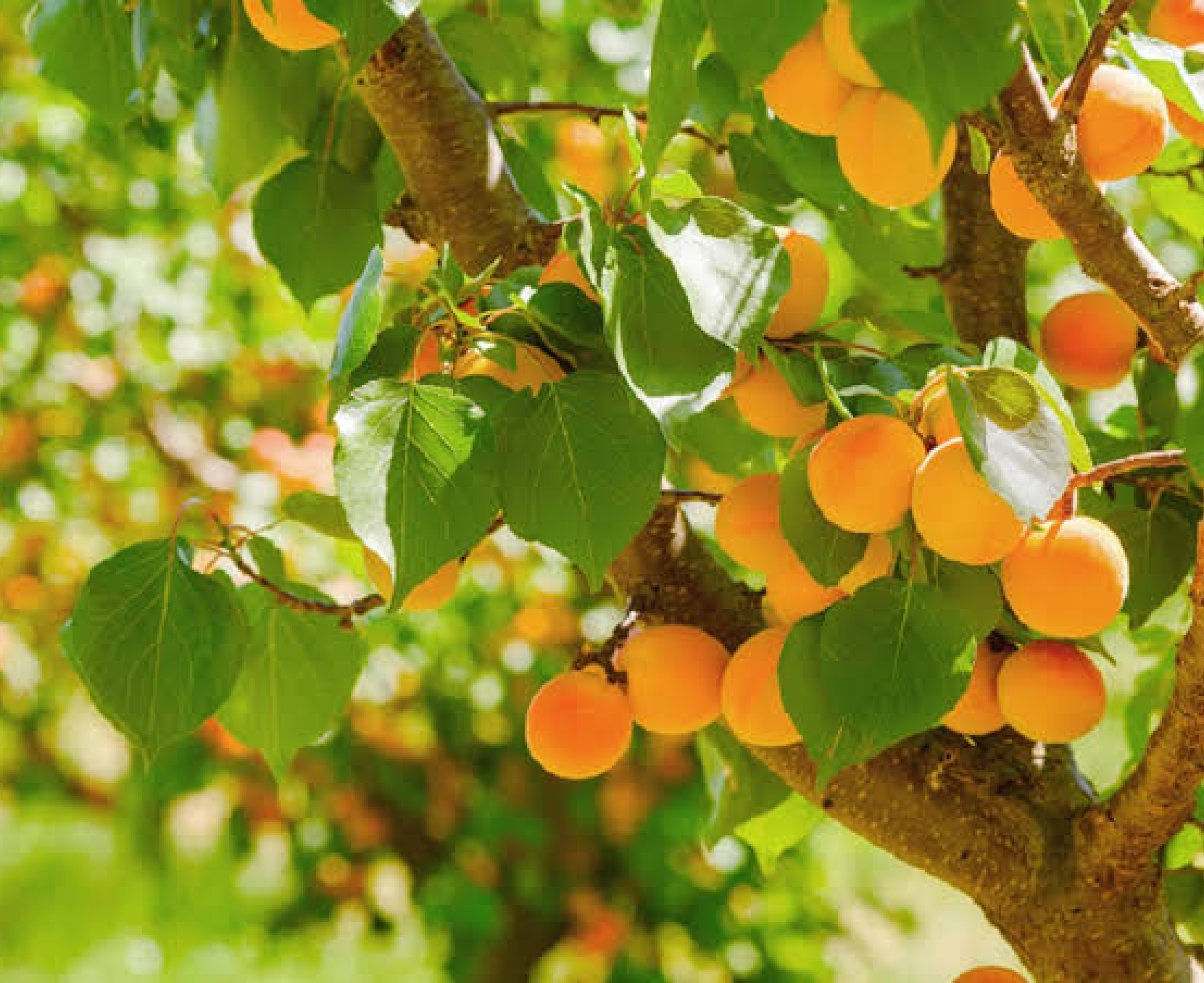
Botanical description. The ordinary apricot is the only representative of the Apricot genus in Kazakhstan. Deciduous tree of medium height 5-8 m. The bark on the old trunks is gray-brown longitudinally cracking. Young shoots are shiny, naked, reddish-brown, with numerous small lenticulates. The leaves are alternate, petiolate, rounded, ovate, elongated at the tip, fine- toothed or double- toothed; 6-9 cm long. Petioles are thin, canaliculate with glands at the base of the plate. The flowers are solitary sessile or on very short pedicels 25-30 mm in diameter, five-dimensional. Hypanthium is cylindrical, greenish-red with five oval, dark red sepals that bend down when flowering. The petals are white with pink veins or pink, rounded, elliptical or obovate. Stamens 25-45. Ginoecium is alone, sitting at the bottom of the hypanthium. The flowers bloom before the leaves appear. Blooms in March-April. The fruits are juicy single–drope, yellowish-red (“apricot”) in color. The drupe is thick-walled, smooth or rough. The skin is velvety-pubescent, yellow to orange in color, usually with a reddish one-sided “tan”; the pulp of the fruit in cultivated varieties is sweet, juicy or dryish. The seeds are flat, obovate, with a dense light brown peel, bitter or sweet. The weight of the fruits is 3-18 g . It bears fruit in June – August. The apricot tree grows for a long time, in a warm climate up to 100 years, abundant fruiting begins from 3-5 years and lasts up to 30-40 years. Flowering buds freeze at a temperature of – 16, -21. Frost-resistant withstand up to – 25 ° C. They are resistant to drought (due to deep root penetration).
Its reddish-brown or brownish-olive, shiny, bare shoots are very elegant, often in places (but not entirely) covered with a grayish film. It is very beautiful at the time of flowering, decorated with numerous large white or pale pink flowers, with dark red bent sepals. Blooms until the leaves bloom for 7-9 days. Wild apricot blooms the very first of the fruit trees, in late March – early April. That is why it often freezes due to April snowfalls and frosts, which are characteristic of the local climate. For the same reason, it normally bears fruit once every 3-4 years. Easily digestible sugars (16-20%) and organic acids (0.32-2.63%), pectin substances (1.10-3.35%), mineral salts and trace elements are harmoniously combined in the pulp of fruits. Apricots are also rich in biologically active substances: vitamin C (17.4 – 20.3mg%), vitamin A (5.2 – 9.8 mg%), vitamin P (445 – 567mg%). The high multivitamin content of apricot fruit significantly increases its value as a dietary and medicinal product. Wild apricot is the most valuable source material for breeding. In the mountains of the Zailiysky and Dzungarian Alatau, fruit-bearing crop forms with high winter hardiness of trees and fruit buds and resistance to fungal diseases are found quite regularly. The weight of fruits in wild forms ranges from 3-18 g, in cultivated forms from 5.5 to 80 g; sometimes there are fruits weighing 130 g. The biological feature of apricot is its ability, in addition to the main growth formed in spring and in the first half of summer, to give a second and even a third wave of growth during the growing season. The fruit buds formed on the shoots of the second wave have the greatest winter hardiness. Apricot is a light-loving mountain plant; it tolerates poorly and suffers greatly from thickening, which is expressed in the drying of the lateral and lower branches, especially in those parts where the crowns of trees are in close contact with one another. Apricot is sensitive to soil salinity.
Distribution. It is widespread in the mountains of the Dzungarian and Zailiysky Alatau, the Ketmen range, in the Kyrgyz and Talas Alatau. It grows mainly singly, in groups or in independent groves on rocky slopes, in the valleys of mountain rivers at an altitude of 900 — 1900 meters above sea level.
Habitats. Southern rocky and gravelly slopes in the lower and middle belts of the mountains. The best thickets are concentrated in the Zailiysky Alatau and on the southern slope of the Dzungarian Alatau, where it occupies an area of about 700 hectares.
Using. In gardening: apricot is decorative. It is distinguished by early and abundant flowering, beautiful autumn foliage. It is used in the utility. Wood for making musical instruments.
In the food industry: dried apricots, pastilles. Apricot fruits are consumed both fresh and dried. The fruits lend themselves well to drying. Dried apricots are especially popular, which is widely used in dietary nutrition. Dried apricots are apricot fruits dried in the sun in the form of halves, without seeds. Properly cooked dried apricots contain from 50 to 60% sugar, with a moisture content of no more than 22%. Dried apricots and apricot juice are useful for pregnant women and patients with cardiovascular diseases. Dried apricots are high in calories, as they contain a lot of easily digestible carbohydrates, are rich in potassium, also contain calcium, magnesium, phosphorus, iron, vitamins, organic acids and other useful substances. Dried apricots as a nutritious, restorative remedy for 100-150 g per day are recommended for people who are weakened, as well as recovering from illness, suffering from chronic diseases (for example, tuberculosis), pregnant women and children.
Seeds (drupes) are eaten like almonds, and milk is obtained by squeezing them. Apricot vodka is prepared from apricot, apricot juice is fermented and then distilled.
In cosmetology: apricot pulp and seeds are used in the manufacture of cosmetics for dry skin, anti-aging products, in nourishing and moisturized masks, in hair care products. Seeds are used for the production of fatty oil used in medicine as a solvent. Powdered apricot gum is used in medicine as a full-fledged substitute for gum arabic. It surpasses gum arabic in terms of emulsifying ability, durability of oil emulsions prepared on it and viscosity. Apricot gum is used as an enveloping agent.


 адрес: ул. И.Жансугурова 187а,